COST-SHARE FUNDING AVAILABLE TO AGATE CD LANDOWNERS
The Agate Conservation District (CD) received $25,000 grant from Colorado Matching Grants program to provide up to 50% cost-share assistance to landowners in the conservation district to install conservation practices on their land. Practices include but are not limited to; livestock wells, solar pumping systems, stock water wells, pipelines, cross fencing dams, diversions, terraces, spring developments, windmills, windbreaks, shelterbelts, living snow fences, alternative energy projects and treatment of noxious weeds to name a few.
The cost-share funds are a service of the Agate CD to help landowners improve and enhance their land. Landowners must submit application for consideration of conservation practices to Agate. Approved applications will receive up to 50% reimbursement of actual cost of conservation practices installed. Funding will not be approved for practices already installed. No practice may be started until application is approved. All approved applications must meet Natural Resource Conservation Service (NRCS) guidelines and specifications. Applications will be considered on a conservation ranking system.
Contact Agate CD, P O Box 215, at 504 Washington Ave., Simla, Colorado 80835 or phone (719) 541-2359 ext 101 to request an application or for more information.
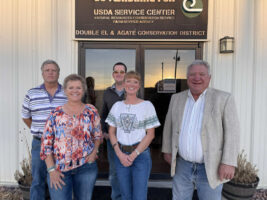
2011 Grant Projects: Landowners receiving various grants through Double El & Agate Conservation District 2011 grant project :
Double El CD Matching Grants program provided $34,600 cost share financial assistance to landowners to install needed conservation practices. Forty-nine requests were received, requesting $81,892 cost share assistance. Twenty-seven projects were completed and received $34,600 in funding assistance. Producer’s project were capped at $2000 in order to be able to serve more landowners and complete more projects.
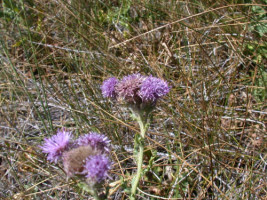
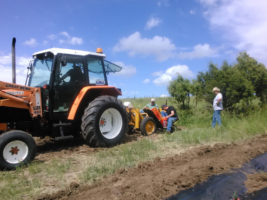
The following projects were funded: Three landowners treated 129 acres infested with Canada Thistle benefiting 1,440 acres. Eight landowners installed windbreaks for a total of 12,194 feet and 1 living snow fence project protecting from wind erosion and providing public safety of roadways and benefited 1,070 acres. Two fence projects for windbreak livestock exclusion. Two cross fencing projects for a total of 7,927 feet and benefiting 1,170 acres to improve rangeland management. Three terraces/diversion repair projects for a total of 6,155 feet and benefited 1,280 acres and protected from water erosion. One solar pumping system, five livestock wells and pumping systems, three livestock tanks, two pipelines for 4,561 feet improved rangeland management and benefited 3,020 acres. Total acres benefited were 7,940 acres and 23.5 tons of soil erosion was saved.
Agate CD Matching Grants Program provided $30,000 cost share financial assistance to landowners to install needed conservation practices. Twenty three project requests were received for cost share funding request of $69,435. Eleven projects were approved and completed for $30,000 total cost share reimbursements. Total Projects costs were $66013.45. Landowners provided $36013.45 matching funds for completed projects.
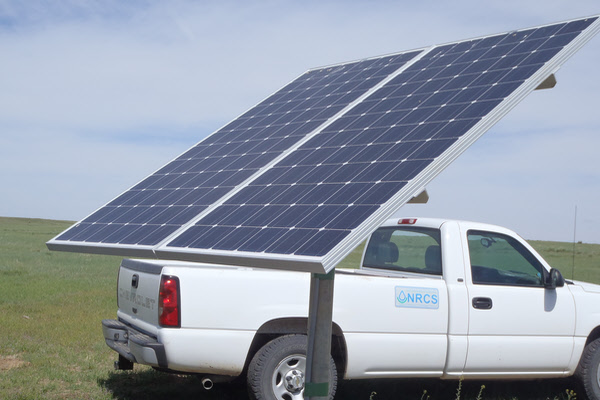
The following projects were funded: Three landowners treated 117 acres of Canada thistle infestations and benefited 560 acres. Three livestock wells were installed benefiting rangeland management and provided needed water facility for the drought conditions causing limited grazing. Five solar pumping systems benefited 3040 acres and assisted in rangeland management with drought conditions. Six livestock tanks for rangeland management assistance and benefited 3,200 rangeland acres. One pipeline for 3,417 feet to assist improved rangeland management and benefited 1280 acres. Total acres benefited were 5200 acres and 7.9 tons of soil erosion.
El Paso & Elbert Counties Install New Living Snow Fences
2011 Living Snow Fence Program
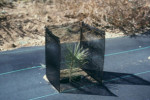
El Paso County and Elbert County partnered with Double El and Agate Conservation Districts again for the 2011 Living Snow Fence program. Fourteen year of partnership with El Paso and second year of partnership with Elbert. El Paso 2011 projects: 3 plantings as follows: West Ramah Rd (David & Jessica McMillin) Funk Rd (Emilio Guttierres) and Oil Well Rd (Bob & Billie Hendrix), 535 Rocky Mt Junipers, 4,300 ft weed barrier fabric and about 4,500 ft of barbed wire fence.
Elbert 2011 Projects: 2 plantings CR 46/CR185 (Billy & Juanita Gordon) and CR 162 (Brian Vincent) 860 Rocky Mt Junipers and 180 Ponderosa Pine, 11,100 ft of weed barrier fabric and 12,000 feet of barbed wire
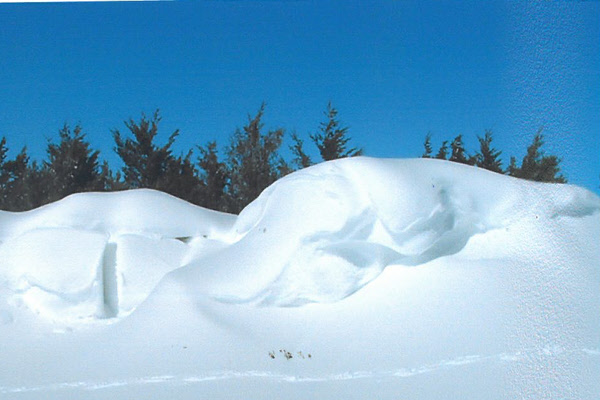
The ultimate goal of the Living snow Fence program is improved traffic safety, benefits to taxpayers with decreased cost of snow removal on public roads and decreased long term costs associated with slatted snow fence maintenance. The longevity of a tree-planting is one of the most valuable attributes of a living snow fence. Trees will live for decades, while a 4-foot wood slated snow fence lasts only 5 to 7 years. We estimate a savings of 3-4 hours savings on snow removal and clean up per snow event in areas having living snow fences. It is estimated $800 per storm event is saved on traffic control, safety and all snow removal efforts. Additional benefits are the creation of wildlife habitats and improved aesthetics.
WINDBREAKS
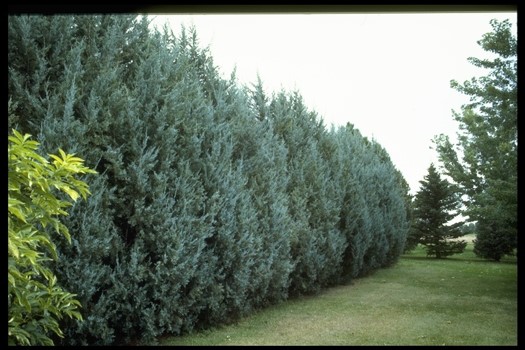
Windbreaks are planted to protect soil, crops, livestock, and homes or other farm buildings from high winds.
Windbreaks provide many environmental benefits such as conserving energy, reducing flood damage, conserving and stabilizing soil, increasing property values, trapping winter moisture, and replenishing water tables. In winter they control snow drifting, reduce cold winter winds and protect livestock. In summer, windbreaks protect gardens, and other field crops from drying winds as well as reduce soil erosion. Windbreaks also provide cover for wildlife.
Properly designed windbreaks can cut energy costs as much as 20 to 40 percent. Properly placed windbreaks can reduce or eliminate snow drifts on roadway, driveway and around buildings, etc. Most windbreaks are at least two rows or no more than 7 rows.
To give the best protection windbreaks must be dense enough to reduce wind velocity. They must be located far enough from farm buildings, paths, and driveways to allow snow drifting where it will be beneficial instead of a nuisance. Every windbreak should include one or more rows of evergreens for winter protection and at least one row of tall hardwoods for maximum summer protection. It is particularly important to have low growing shrubs on the windward side to prevent wind from sweeping under the windbreak, drying the ground in summer and carrying snow into the farm yard in winter.
Maintenance: Replacements should be made as soon as possible with the same species. This is particularly important the first few years. A good windbreak is one having uniform density and height throughout.
There are designs for windbreaks that can be planned for you by the staff at the conservation districts or the NRCS. Call to schedule an appointment to get your custom design that will be developed using the factors of your land that affect your windbreak design.