Noxious Weeds

PO Box 215
504 Washington
Simla, Colorado 80835

719-541-2359
fax 719-541-3061
Cherylchurchscd@worldnet.att.net
www.4conservation.org
Noxious Weeds
All noxious weeds are non-native species and a  plant is named by the State weed advisory board as a noxious weed when it meets one or more of the following criteria:

Aggressively invades or is detrimental to economic crops or native plant communities.

Is poisonous to livestock.  

Is a carrier of detrimental insects, diseases or parasites.  

The direct or indirect effect of the presence of this plant is detrimental environmentally  to natural or agricultural ecosystems.  

All noxious weeds are invasive due to the lack of natural insects and disease to keep their populations in check.

More detailed explanations of each noxious weed occurs with the photographs.


======================================================================


  Leafy Spurge
Can cause severe irritation of the mouth and digestive tract in cattle which may cause death.  

Perennial, up to 3' tall; reproduces by vigorous rootstalks and seed.  Leaves are alternate, narrow, 1 to 4" long.  Stems are thickly clustered.  Flowers are yellowish green, small, arranged in numerous clusters and subtended by paired heart-shaped, yellow-green bracts.  The entire plant contains a milky juice.  Seeds are oblong, grayish to purple, contained in a 3-celled capsule, each cell containing one seed.

Pink buds which form new shoots are common on crowns and roots.  Rooting depths of over 14' are reported.

Capsules explode when dry, often projecting seeds as far as 15 feet.  Seeds may be viable in the soil for at least 8 years.  An extensive root system containing large nutrient makes leafy spurge extremely difficult to control.

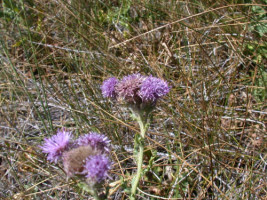
Canada thistle A colony forming perennial from deep and extensive horizontal roots.  Difficult to control; breaking up roots by plowing only increases the number of plants.


Canada ThistleCirsium arvense


Differs from other species of the true thistle in that there are male and female flower heads, and these are on separate plants.  By asexual reproduction, it is possible that a colony of male plants would produce no fruits, but still maintain itself.  Flowering occurs during July and August.


Dalmatian ToadflaxLinaria genistifolia
Stems are 1 to 4' tall, ridged, branching above.  Leaves are alternate, oblong or lance-shaped, divided into spiny-topped irregular lobes.  Flowers are unisexual, on separate plants; flowers purple (occasionally white) in heads 1/2 to 3/4 inch in diameter.  Fruits are about 1/8 inch long, somewhat flattened, brownish, with a tuft of hairs at the top.


Dalmatian toadflax is a perennial, up to 3' tall, reproducing by seed and underground root stalks.  Leaves are dense, alternate, entire, upper leaves are conspicuously broad-based.  Flowers are borne in axils of upper leaves and are 2-lipped, 3/4 to 1 1/2 inches long with a long spur, yellow with an orange, bearded throat.  Fruit is a 2-celled capsule with many irregularly angled seeds.  Flowers appear mid-summer and continue to flower until early fall.  Leaves individually clasp the stem.
It is aggressive and can be found along roadsides and on rangeland where it can become a serious problem by crowding out desirable forage.  An extensive and deep root system along with a waxy leaf make this an extremely difficult plant to control.


Diffuse KnapweedCentaurea diffusa

Flowering heads are numerous and narrow.  Flowers are white to rose or sometimes purplish.  Margins of the bracts are divided like the teeth of a comb, and bracts are tipped with a definite slender spine.
Diffuse knapweed infests roadsides, waste areas and dry rangelands, and as a highly competitive plant, threatens to exclude may desirable species.  Flowering occurs from July to September.


Field BindweedConvolvulus arvensis

A perennial from an extensive root system, often climbing or forming dense tangled mats.  Stems are prostrate, 1 to 4 feet long.  Leaves are alternate and shaped like arrowheads.  The flowers are bell- or trumpet-shaped, white to pinkish, approximately 1 inch in diameter with 2 small bracts located 1 inch below the flower.  Fruit is a small, round capsule, usually 4-seeded.
Because of its remarkable adaptability to different environmental conditions, it may be found at altitudes as high as 10,000 feet.  The flowering period is from late June until frost in the fall.
This weed is a diffusely branched annual or short-lived perennial, 1 to 2' tall, stems are rough to the touch.  Seedlings have finely divided leaves covered with short hair.  Herbicides are most effective when applied at this early growth stage.


======================================================================


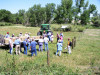
Leafy Spurge Project Tour
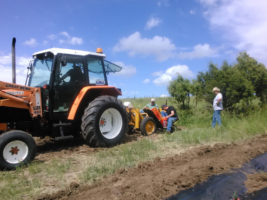
Double El CD sponsored a Leafy Spurge Project Weed Tour on July 13, 2011.  They viewed the progress that has been accomplished over the past few years with the cost share grant on Leafy Spurge along Big Sandy Creek drainage area, weed identification assistance, reviewed different treatment uses and results.  Big Sandy School allowed the lease of a school bus for transporting participants on the tour.  Thanks to Farm Credit of Southern Colorado who provided the free meal to all participants. 


======================================================================


Double El/Agate Conservation District